Activities of our Network
Management of the Welfare Assessment System and Support Instruments
Conditions of Use and Implementation
To facilitate a harmonized and effective implementation of the assessment systems, the Welfare Quality Network will help to define the conditions of use and describe the sorts of claims that can be made on the basis of the outcomes of the assessments. The Network is also available to evaluate implementation plans proposed by stakeholders and to advise on compliance with the defined conditions of claims.
Roadmap towards implementation of Welfare Quality® assessment systems
This document is meant to give guidance to collaborative efforts between (partners of) the Welfare Quality Network and companies in supply chains, aiming to implement welfare assessments according to Welfare Quality® protocols. It aims to describe the different stages in an implementation trajectory as well as related requirements, roles of partners, involvement of the WQN, etc. It also briefly describes the claims a company can make based on the outcomes of a specific stage.
This roadmap should be discussed and agreed between a company and a Welfare Quality Network partner during the definition of their collaboration. Confidentiality is an important issue in this process. From the beginning, it has to be agreed between the company and the Welfare Quality Network what the level of confidentiality is throughout the different steps of the process.
In this process, the Welfare Quality Network is represented by the WQN Implementation Committee 1.
At the start of the collaboration, indicative cost estimates are provided to the commercial partner, including costs of the work of the WQN partner and costs of the involvement of the Welfare Quality Network in the different phases described below.
1 The WQN Management Team accepted to act as Implementation Committee (see notes GA 14 December 2011)
Scope
Involved: The commercial partner and the WQN partner. The WQN partner informs the WQN Implementation Committee.
Activities: In this phase a company interacts with a WQN partner to define aims, goals, and the way of implementation of the Welfare Quality® protocols. This includes, for instance, the definition of the likely number of farms involved, who will conduct the assessments, the aspiration level (acceptable, enhanced, excellent), whether all farms should be included (i.e., is the aspiration level determined by the lowest-level farm), the expected timeline, and how outcomes will be used (B2B, product marketing, own label, WQ label, etc.). The collaboration is defined, including the WQN involvement and approach as described in this document, being a requirement for WQ name and logo use.
Output: Document describing the scope of the planned use of Welfare Quality® protocols. This document is also made available to the Implementation Committee.
Fact finding
Involved: The commercial partner, the WQN partner, and the farms involved.
Activities: The WQN partner visits a sample of farms that will be included in the assessment programme and carries out Welfare Quality® assessments. The aim is to obtain an overview of the welfare status of those farms and to estimate the scope for improvement. The capacities of the company (organization, infrastructure) relevant for a successful implementation of WQ assessments are also evaluated.
Output: Report with a preliminary assessment of the farms and a discussion of the welfare status of the farms in this specific supply chain. If applicable, areas requiring attention will be identified. Confidential advice on the likelihood of successful implementation may, on request, be provided by the Implementation Committee.
Claims: ‘We are working with the WQN to define strategies in our business to assess and safeguard animal welfare’
Involved: Commercial partner and WQN partner, WQN Implementation Committee.
Activities: The WQN partner, in collaboration with (other partners of) the WQN, defines the trajectory to implement structures and activities to achieve the defined goal. This includes the definition of and requirements for training, assessors, farm visits, data handling (by WQN), WQN partner involvement, etc., as well as a description of a pilot phase and a full timeline.
Output: Description of the trajectory of implementation (including an estimation of the financial consequences) of Welfare Quality® assessments in the specified supply chain. This has to be agreed by the company, the WQN partner, and the WQN Implementation Committee.
Claims: ‘We are working with the WQN to implement animal welfare assessment in our supply chain’
Involved: Commercial partner, WQN partner, WQN Implementation Committee, and selected farms.
Activities: In this pilot, assessors linked to the company are trained by WQN partner(s) (or certified WQ trainers) and a selection of farms in the company’s supply chain is assessed. The data are handled and integrative scores calculated by WQN partners.
Output: A report with the results of the assessments on the pilot farms and a critical evaluation of the pilot phase defining necessary improvements. The report is also made available to the WQN Implementation Committee to support the decision process.
Claims:
For the assessed farms: ‘Assessed in collaboration with the WQN’
For the company: ‘We are working with WQN to implement welfare assessment and to use this to improve welfare in our supply chain’
Involved: Commercial partner, WQN partner, and WQN Implementation Committee.
Activities: Definition of further implementation trajectory on the basis of the results from the pilot and decision on agreement to use the Welfare Quality® name and logo.
Output: A plan for further implementation in the whole supply chain as well as related conditions (re-training of assessors, changes of routines, etc.). This plan needs to be agreed between the company, the WQN Implementation Committee, and involved WQN partners. The company and WQN should also sign an agreement allowing the use of the logo by the company under the requirement of implementing the agreed plan. A positive decision will be made available to the whole WQN (a negative one will not).
Claims: For the assessed farms: ‘We are working with WQN to implement welfare assessment and to use this to improve welfare in our supply chain (as above)’
Involved: Commercial partner and farms in the supply chain, WQN partner, WQN Implementation Committee.
Activities: Roll-out of the implementation plan including further training, assessments, calculation of scores, and communication of the results (Business to Business, to consumers, or otherwise). This includes the possible use of the Welfare Quality® label together with the assessed level (acceptable, enhanced, excellent).
Output: Fully implemented assessment scheme including a growing database with assessment outcomes.
Claims:
For the assessed farms: ‘Welfare Quality® assessed’
For the company: ‘Our products are Welfare Quality® assessed’
Training
The assessor is a ‘critical component’ of every certification and inspection scheme. Appropriate and recognized training in the use and practical application of the welfare assessment protocols is essential to ensure uniform scoring. Moreover, assessors should be regularly re-evaluated when they are active in the field to ensure retention of objectivity, impartiality and repeatability in scoring. The Welfare Quality Network is available to ‘train trainers’ and to evaluate the training programmes delivered by such trained trainers. The Network can also facilitate and/or participate in the regular re-evaluation of assessors.
WQNetwork Qualification Outline
The Welfare Quality protocols for Poultry, Pigs and Cattle have been widely used as the basis for experimental project work. They have also been included (in part or totally) in some farm assurance schemes as well as being used as a training tool in outcome assessment for interested bodies (veterinary agencies, state inspection bodies). An examination process was developed. To ensure continuation of the high standards set by the Welfare Quality Network, the process includes the determination and the certification of the competency of candidates wishing to assess animal welfare according to the requirements of the Welfare Quality protocols. The process is described below.
A candidate will be required to demonstrate a capacity to effectively assess animal welfare while ensuring that the requirements of the Welfare Quality protocols are met. This will be done in three parts:
a written examination,
tests against established reference materials, and
a practical assessment on-farm and, if required, at a slaughterhouse.
Part 1: Written exam
The areas to be covered: definitions, sampling strategies, sample sizes, order of measures, technical questions, scoring scales and thresholds, and methods to carry out the measures.
A pool of questions is available; 15 questions are to be randomly selected from the pool.
Four to five options are proposed for answers to each question; one or several correct answers may be possible.
This is not an open book exam.
A minimum of 75% correct answers is necessary to pass Part 1 exam.
Part 2: Test against references (pictures and videos)
The areas to be covered are the measures of the Welfare Quality protocol which can be viewed from photos or videos (e.g., body condition score, lameness).
A set of established gold standard reference materials (photos and videos) is available from the members of the Welfare Quality Project and the Welfare Quality Network, provided by the species responsible.
A Cohen’s Kappa value of concordance, PABAK or correlations for quantitative measures will be used to assess the candidate’s agreement with standard reference.
The candidate must achieve a Cohen’s Kappa value of at least 0.65 on average on all measures and at least 0.5 for any individual measure to pass Part 2 exam. The same applies to the correlations and PABAK.
Part 3: Witnessed on farm (and/or at slaughter)
The areas to be covered are any practical issue regarding the organization of the visit and, in some cases, measures the results of which cannot be checked on photos or videos (e.g., distance-based tests of avoidance where live animals have to be used). The results will be checked against those of the examiner.
A checklist is set for each Welfare Quality protocol. The checklist will consider critical mistakes (not compatible with passing the exam); major mistakes (−1 point from the initial score of 10), moderate mistakes (−0.5 point) and minor mistakes (−0.25 point). To standardize the examination for the different protocols (that have a different number of measures), the exam will contain a maximum of 100 to 110 points to be assessed considering the variables and number of animals or pens to be assessed.
The checklist will include the assessment of a professional approach to the producer and a careful approach and handling of animals.
Candidates will have to explain how they would approach the producer, assess the farm, deal with practical issues and obstacles, and choose a sample size.
When performing measurements on animals, it will be checked that the candidate approaches/handles the animals carefully.
A minimum of 65 points out of 100 is necessary to pass this part of the exam.
The candidate must pass ALL sections in order to achieve an overall pass. In case the candidate fails one part of the exam, this can be repeated within three months after failing. After three months, it will be mandatory to repeat all three parts of the exam. The final responsible of the examination process will be the species leader (responsible of a species). This includes one or more persons in charge of the examination process for cattle, pigs, and poultry.
Duration of certification
Certification duration: finite (5 years).
After 5 years
After 5 years, all assessors will be required to do the WQNetwork examination described above to ensure that their knowledge and consistency remain relevant and that they are familiar with the current version of the Welfare Quality protocols. This means the assessor will be required to undergo a new examination consisting of 3 parts: a written exam, test against references, and witnessed on farm (and/or at slaughter).
Training of examiners
The WQN examiner team is formed of those people selected to be responsible for the various species (species leader) and qualified examiners. The responsible team for poultry are Ingrid de Jong, Thea Van Niekerk, and Henk Gunnink. Those responsible for pigs are Antonio Velarde, Antoni Dalmau, and Joaquim Pallisera. The persons responsible for cattle are Christoph Winckler, George Stilwell, and Antoni Dalmau.
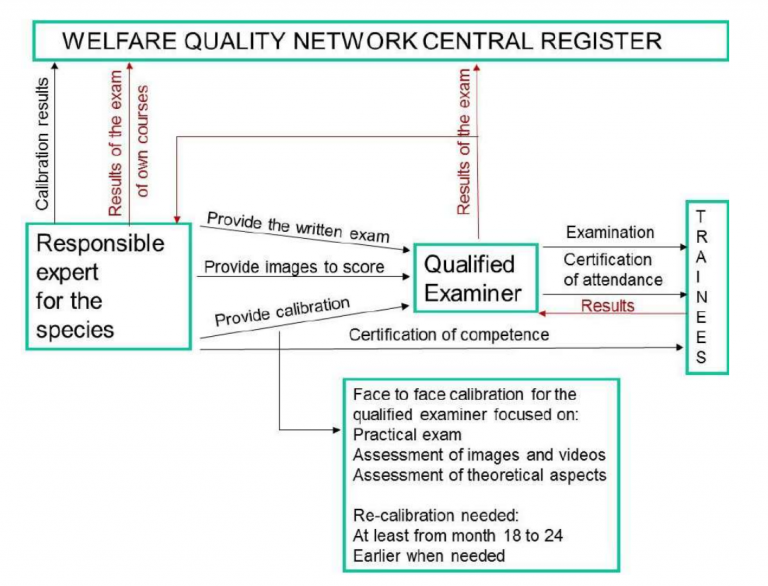
A qualified examiner is a person that can conduct the exam process on behalf of the responsible expert for the species. To be a qualified examiner, the person needs to be trained first and subjected later to a calibration process regularly.
The requirements to be an examiner include:
A pass mark of 90% for the written exam.
In tests against references, the candidate must achieve a ‘composite score’ (mean) of 0.75 or more where multiple measures are assessed, and the score for any individual measure must not fall below 0.65.
For Part 3 of the examination (witnessed on farm and/or at slaughter) each candidate must achieve an overall score of 80%.
In the case of an update of a protocol, all examiners need to be trained in the new aspects before they can be deemed qualified examiners of the new protocol. Once trained, a calibration process is required at least between month 18 and 24 after the last calibration (or training) or after the examination of 60 people (e.g., 4 courses of 15 persons each). This process should be repeated every 24 months or 60 people trained.
Andy Butterworth is a qualified examiner for broilers.
FAQ's - Frequently Asked Question’s
1. Can we provide an examination for ‘parts’ of the protocol (i.e. measures selected by the user)
No, we only offer one examination covering the entire protocol – not for parts of it.
2. Who will be approved to train?
Candidates can be trained by any person or organisation. The performance of the candidates will be assessed by the WQN examiner team, based on fixed criteria (as described above). Training opportunities are also available from the WQNetwork through the contacts mentioned below or any other member of the WQN.
3. How will the process of examination be registered?
On successful completion of the first examination, the candidate will be issued with a certificate that prescribes the period/duration of approval and the scope (species, limitations) of the approval provided. The format of the approval certificate will be agreed by the WQNetwork. If the participant fails to maintain approval status through periodic and ongoing validation activity, then both the certificate and approval will be revoked and the certificate must be returned to the original assessment organisation.
The WQN will produce a central register of the names of the examiners and examinees, as well as the results of the repeatability testing, the written exam, and the exam on farm. In the case of a qualified examiner, this file will also be sent to the responsible expert for the species.
The experts responsible for the species will be in charge of providing the certificates of achievement, and the person responsible for the training course will be in charge of awarding a certificate of attendance. The experts responsible for each species act as supervisors of the other examiners, and should also be able to perform exams with some frequency. These exams could include those for training or calibration of qualified examiners, as well as the exams conducted by the leader of the particular species at the end of a course.
The examiners will be able to sign the certificates of achievement only if they are specifically authorized to do so by the species responsible from WQNetwork.
4. What are the duration and costs?
Stage 1 (first exam)
First exam – The ‘first examination’ process will take 2 half days.
Parts 1 and 2 (written and the test against reference material) on the first half day.
Part 3 (practical assessment at a farm) on the second half day.
The first examination fee is 350 euro per person. To ensure that the process is cost and time effective (and to avoid single candidate exams) a minimum number of 7 candidates will be required to register before an exam course can be run, or alternatively 2450 euros + expenses (travel & accommodation at candidate’s own cost) will be applied for less than 7 candidates.
No. participants – Costs
<7 → 2450 euro + expenses (travel & accommodation at candidate’s own cost)
7 – 15 → Additional: 350 euro extra per person if the group exceeds 7 people*
*For any group greater than 15, a second examination will be organized.
Yearly approval process “Stage 2”
The 5 yearly approval examination – will take 1 day.
The process described above for stage 2 will then be repeated every 5 years to maintain approval status.
The ‘5 year approval’ examination fee is 200 euro per person. To ensure that the process is cost and time effective (and to avoid single candidate exams) a minimum number of 6 candidates will be required to register before an exam course can be run.
Training of examiners
The examination process will take from 2 to 3 half days.
Parts 1 and 2 (written and the test against reference material) on the first two half days.
Part 3 (practical assessment at a farm) on the third half day.
The first examination fee is 500 euro per person. To ensure that the process allows a good assessment of the examiner and at the same time is cost and time effective a minimum number of candidates is not required but a maximum of 7 should be considered. In cases with less than 5 people, the costs of the course will be fixed at 2500 euros + expenses (travel & accommodation at candidate’s own cost).
5. Who should I contact?
The three species protocols have a ‘first contact person’ – this person will facilitate the assessment
process and may refer you to others in the Welfare Quality Network for further information.
For broilers – please contact Ingrid de Jong ingrid.dejong@wur.nl
For laying hens – please contact Thea Van Niekerk thea.vanniekerk@wur.nl
For pigs – please contact Antoni Dalmau antoni.dalmau@irta.cat
For cattle – please contact Christoph Winckler christoph.winckler@boku.ac.at
Data Handling and Uses of the Database
The application (by trained assessors) of Welfare Quality® assessment systems in livestock production will generate data from individual farms all over Europe (and beyond). The Network is available to support the correct handling of data and its processing into integrated welfare assessment scores. This support includes, for instance:
Provision of a template for entering data in an appropriate format;
Checking data entries;
Creation of specific user databases and access rights (enabling users to access their data and scores);
Calculation of overall welfare scores;
Feedback of the results in Excel files;
Simulation of improvements;
Etc.
To benefit from these services, please visit WAFA.
The large amounts of data (results from measures and calculated scores) from the above activities will be carefully stored to ensure the safe and steady accumulation of knowledge. Data collected at several locations and at various intervals can subsequently be used (with appropriate protection of private and commercial interests) to:
Continue to inform stakeholders (e.g., on the progress made by a certain population of farms/certain slaughterhouses, etc.);
Help farmers or slaughterhouse managers to track their progress and compare their status with industry averages (i.e. benchmarking); and
Further analyse the links between welfare problems and identify their associated risk factors.
Stimulating the Adoption of the Welfare Quality® Assessment System
Activities envisaged here include: advisory services; specific training and support to help farmer organizations or farmer–retailer groups; quality assurance checks to ensure correct use of the system; etc. Continued research and development aimed at extending and refining the Welfare Quality® assessment system for application in other species will also stimulate its adoption. Maintenance and upgrading of the Information Resource on practical welfare improvement strategies will also play an important role in this respect (see below).
Maintenance of the System
Hosting a Web Site
Welfare Quality® established a website to provide information on the progress made in the project, its results and outputs. This website will be maintained by the Welfare Quality Network in order to continue the dissemination of information on animal welfare and its assessment, as well as on the application of practical welfare improvement strategies.
Publication of Protocols
The Welfare Quality® protocols were published at the end of the project and were extremely well received. The protocols have only been published in English so far, but the Welfare Quality Network is available to support translations into other major languages and to check their correctness and quality. It will also be necessary to regularly publish and disseminate new releases of the protocols.
Upgrading the System
Upgrading of Protocols
The existing Welfare Quality® assessment protocols and evaluation models need to be regularly updated and refined on the basis of new scientific findings, societal developments, and practical experiences gained during implementation. For example, some new measures may prove easier to collect, or they may be more precise or more reliable than those contained in the current Welfare Quality® protocols.
The Welfare Quality Network can provide the necessary expertise for the stringent testing of validity, repeatability, and robustness of a new measure, as well as the necessary process to translate the data into a value score.
Refinement of the scoring system
Currently, the Welfare Quality® scoring system proposes that animal units should be placed in one of four welfare categories according to the following rules:
“Excellent”: requires a score of at least 55 on all criteria and 80 on 2 of them.
“Enhanced”: requires at least 20 on all criteria and 55 on 2 of them.
“Acceptable”: requires at least 10 on all criteria and 20 on 3 of them.
“Not classified”: failure to meet the above requirements.
It was recommended that after some years of implementation and visible improvements at farms and abattoirs, the requirements should be increased to:
“Excellent”: at least 55 on all criteria and 80 or more on 2 of them.
“Enhanced”: at least 20 on all criteria and 55 or more on 3 of them.
“Acceptable”: minimum of 20 on all criteria.
“Not classified”: failure to meet the above requirements.
On the basis of assessment data, the Welfare Quality Network can establish what levels are actually achieved for the different measures on farms and in slaughterhouses. Such data represent essential input to a consultation and negotiation process with stakeholders to determine whether there has been sufficient welfare improvement to allow implementation of the second set of rules.
A Resource on Welfare Improvement Strategies
The provision of sound advice on ways of avoiding welfare risks or resolving problems is critical for the uptake and implementation of the Welfare Quality® assessment systems and for improving farm animal welfare in general. Remedial measures developed within and outside the Welfare Quality® project are described in a Technical Information Resource, which also details the causes and consequences of welfare problems. The Welfare Quality Network can maintain, update (as new results emerge), extend (to include new strategies and new species), and disseminate this resource.
Promoting Stakeholder Involvement
The active participation of a broad range of stakeholders (farmers, breeders, retailers, certification bodies, NGOs, national governments, etc.) in both research and in an advisory capacity greatly facilitated the uptake of Welfare Quality® outcomes and helped to guide the development of follow-on projects. Through collaborative ventures with, for instance, the European Animal Welfare Platform, a multi-stakeholder project committed to safeguarding and advancing farm animal welfare, the partners in the Welfare Quality Network aim to promote further stakeholder involvement.
Prioritizing and Facilitating Research
Through experience gained during the management of the systems and the efforts to support implementation, areas requiring further research are expected to be highlighted. Such areas may include: fundamental biological knowledge required to assess, safeguard, and improve all aspects of animal welfare, as well as relevant developments in stakeholder or consumer attitudes, areas of cross-compliance, and social, economic, and environmental policy. A prioritization of such R&D needs would be helpful for a range of EU and national research funding bodies.
‘State of the Art’ Advice
It is likely that a number of stakeholders (producers, retailers, policy groups, etc.) will occasionally require position papers or state-of-the-art reviews on specific farm animal welfare issues (problems, risk factors, good practices, etc.). With its broad and widely respected expertise, the Network is extremely well positioned to prepare or solicit requests for such documents.