Training
The assessor is a ‘critical component’ of every certification and inspection scheme. Appropriate and recognized training in the use and practical application of the welfare assessment protocols is essential to ensure uniform scoring. Moreover, assessors should be regularly re-evaluated when they are active in the field to ensure retention of objectivity, impartiality and repeatability in scoring. The Welfare Quality Network is available to ‘train trainers’ and to evaluate the training programmes delivered by such trained trainers. The Network can also facilitate and/or participate in the regular re-evaluation of assessors.
WQNetwork Qualification Outline
The Welfare Quality protocols for Poultry, Pigs and Cattle have been widely used as the basis for experimental project work. They have also been included (in part or totally) in some farm assurance schemes as well as being used as a training tool in outcome assessment for interested bodies (veterinary agencies, state inspection bodies). An examination process was developed. To ensure continuation of the high standards set by the Welfare Quality Network, the process includes the determination and the certification of the competency of candidates wishing to assess animal welfare according to the requirements of the Welfare Quality protocols. The process is described below.
A candidate will be required to demonstrate a capacity to effectively assess animal welfare while ensuring that the requirements of the Welfare Quality protocols are met. This will be done in three parts:
a written examination,
tests against established reference materials, and
a practical assessment on-farm and, if required, at a slaughterhouse.
Part 1: Written exam
The areas to be covered: definitions, sampling strategies, sample sizes, order of measures, technical questions, scoring scales and thresholds, and methods to carry out the measures.
A pool of questions is available; 15 questions are to be randomly selected from the pool.
Four to five options are proposed for answers to each question; one or several correct answers may be possible.
This is not an open book exam.
A minimum of 75% correct answers is necessary to pass Part 1 exam.
Part 2: Test against references (pictures and videos)
The areas to be covered are the measures of the Welfare Quality protocol which can be viewed from photos or videos (e.g., body condition score, lameness).
A set of established gold standard reference materials (photos and videos) is available from the members of the Welfare Quality Project and the Welfare Quality Network, provided by the species responsible.
A Cohen’s Kappa value of concordance, PABAK or correlations for quantitative measures will be used to assess the candidate’s agreement with standard reference.
The candidate must achieve a Cohen’s Kappa value of at least 0.65 on average on all measures and at least 0.5 for any individual measure to pass Part 2 exam. The same applies to the correlations and PABAK.
Part 3: Witnessed on farm (and/or at slaughter)
The areas to be covered are any practical issue regarding the organization of the visit and, in some cases, measures the results of which cannot be checked on photos or videos (e.g., distance-based tests of avoidance where live animals have to be used). The results will be checked against those of the examiner.
A checklist is set for each Welfare Quality protocol. The checklist will consider critical mistakes (not compatible with passing the exam); major mistakes (−1 point from the initial score of 10), moderate mistakes (−0.5 point) and minor mistakes (−0.25 point). To standardize the examination for the different protocols (that have a different number of measures), the exam will contain a maximum of 100 to 110 points to be assessed considering the variables and number of animals or pens to be assessed.
The checklist will include the assessment of a professional approach to the producer and a careful approach and handling of animals.
Candidates will have to explain how they would approach the producer, assess the farm, deal with practical issues and obstacles, and choose a sample size.
When performing measurements on animals, it will be checked that the candidate approaches/handles the animals carefully.
A minimum of 65 points out of 100 is necessary to pass this part of the exam.
The candidate must pass ALL sections in order to achieve an overall pass. In case the candidate fails one part of the exam, this can be repeated within three months after failing. After three months, it will be mandatory to repeat all three parts of the exam. The final responsible of the examination process will be the species leader (responsible of a species). This includes one or more persons in charge of the examination process for cattle, pigs, and poultry.
Duration of certification
Certification duration: finite (5 years).
After 5 years
After 5 years, all assessors will be required to do the WQNetwork examination described above to ensure that their knowledge and consistency remain relevant and that they are familiar with the current version of the Welfare Quality protocols. This means the assessor will be required to undergo a new examination consisting of 3 parts: a written exam, test against references, and witnessed on farm (and/or at slaughter).
Training of examiners
The WQN examiner team is formed of those people selected to be responsible for the various species (species leader) and qualified examiners. The responsible team for poultry are Ingrid de Jong, Thea Van Niekerk, and Henk Gunnink. Those responsible for pigs are Antonio Velarde, Antoni Dalmau, and Joaquim Pallisera. The persons responsible for cattle are Christoph Winckler, George Stilwell, and Antoni Dalmau.
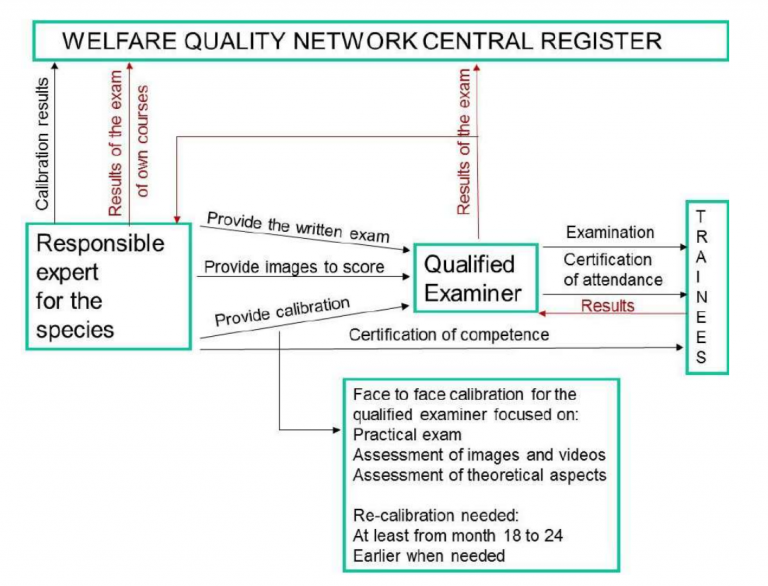
A qualified examiner is a person that can conduct the exam process on behalf of the responsible expert for the species. To be a qualified examiner, the person needs to be trained first and subjected later to a calibration process regularly.
The requirements to be an examiner include:
A pass mark of 90% for the written exam.
In tests against references, the candidate must achieve a ‘composite score’ (mean) of 0.75 or more where multiple measures are assessed, and the score for any individual measure must not fall below 0.65.
For Part 3 of the examination (witnessed on farm and/or at slaughter) each candidate must achieve an overall score of 80%.
In the case of an update of a protocol, all examiners need to be trained in the new aspects before they can be deemed qualified examiners of the new protocol. Once trained, a calibration process is required at least between month 18 and 24 after the last calibration (or training) or after the examination of 60 people (e.g., 4 courses of 15 persons each). This process should be repeated every 24 months or 60 people trained.
Andy Butterworth is a qualified examiner for broilers.
Welfair Academy
Since the official launch of the certification in 2019 by the WQN member IRTA, Welfair® has become an international benchmark in animal welfare. It is currently the leading certification standard in Spain and Portugal, and it has a growing presence in 10 countries in Europe and Latin America. With more than 1,200 certified companies and over 35,000 assessed farms and slaughterhouses, the label Welfair® can be found in thousands of products such as meat, dairy, eggs and processed foods thereof. Welfair® aims to drive continuous improvements in animal welfare throughout the agrifood value chain, and to provide comprehensive on-line trainings in animal welfare assessment via Welfair® Academy.
FAQ's - Frequently Asked Question's
1. Can we provide an examination for ‘parts’ of the protocol (i.e. measures selected by the user)
No, we only offer one examination covering the entire protocol – not for parts of it.
2. Who will be approved to train?
Candidates can be trained by any person or organisation. The performance of the candidates will be assessed by the WQN examiner team, based on fixed criteria (as described above). Training opportunities are also available from the WQNetwork through the contacts mentioned below or any other member of the WQN.
3. How will the process of examination be registered?
On successful completion of the first examination, the candidate will be issued with a certificate that prescribes the period/duration of approval and the scope (species, limitations) of the approval provided. The format of the approval certificate will be agreed by the WQNetwork. If the participant fails to maintain approval status through periodic and ongoing validation activity, then both the certificate and approval will be revoked and the certificate must be returned to the original assessment organisation.
The WQN will produce a central register of the names of the examiners and examinees, as well as the results of the repeatability testing, the written exam, and the exam on farm. In the case of a qualified examiner, this file will also be sent to the responsible expert for the species.
The experts responsible for the species will be in charge of providing the certificates of achievement, and the person responsible for the training course will be in charge of awarding a certificate of attendance. The experts responsible for each species act as supervisors of the other examiners, and should also be able to perform exams with some frequency. These exams could include those for training or calibration of qualified examiners, as well as the exams conducted by the leader of the particular species at the end of a course.
The examiners will be able to sign the certificates of achievement only if they are specifically authorized to do so by the species responsible from WQNetwork.
4. What are the duration and costs?
Stage 1 (first exam)
First exam – The ‘first examination’ process will take 2 half days.
Parts 1 and 2 (written and the test against reference material) on the first half day.
Part 3 (practical assessment at a farm) on the second half day.
The first examination fee is 350 euro per person. To ensure that the process is cost and time effective (and to avoid single candidate exams) a minimum number of 7 candidates will be required to register before an exam course can be run, or alternatively 2450 euros + expenses (travel & accommodation at candidate’s own cost) will be applied for less than 7 candidates.
No. participants – Costs
<7 → 2450 euro + expenses (travel & accommodation at candidate’s own cost)
7 – 15 → Additional: 350 euro extra per person if the group exceeds 7 people*
*For any group greater than 15, a second examination will be organized.
Yearly approval process “Stage 2”
The 5 yearly approval examination – will take 1 day.
The process described above for stage 2 will then be repeated every 5 years to maintain approval status.
The ‘5 year approval’ examination fee is 200 euro per person. To ensure that the process is cost and time effective (and to avoid single candidate exams) a minimum number of 6 candidates will be required to register before an exam course can be run.
Training of examiners
The examination process will take from 2 to 3 half days.
Parts 1 and 2 (written and the test against reference material) on the first two half days.
Part 3 (practical assessment at a farm) on the third half day.
The first examination fee is 500 euro per person. To ensure that the process allows a good assessment of the examiner and at the same time is cost and time effective a minimum number of candidates is not required but a maximum of 7 should be considered. In cases with less than 5 people, the costs of the course will be fixed at 2500 euros + expenses (travel & accommodation at candidate’s own cost).
5. Who should I contact?
The three species protocols have a ‘first contact person’ – this person will facilitate the assessment
process and may refer you to others in the Welfare Quality Network for further information.
For broilers – please contact Ingrid de Jong ingrid.dejong@wur.nl
For laying hens – please contact Thea Van Niekerk thea.vanniekerk@wur.nl
For pigs – please contact Antoni Dalmau antoni.dalmau@irta.cat
For cattle – please contact Christoph Winckler christoph.winckler@boku.ac.at